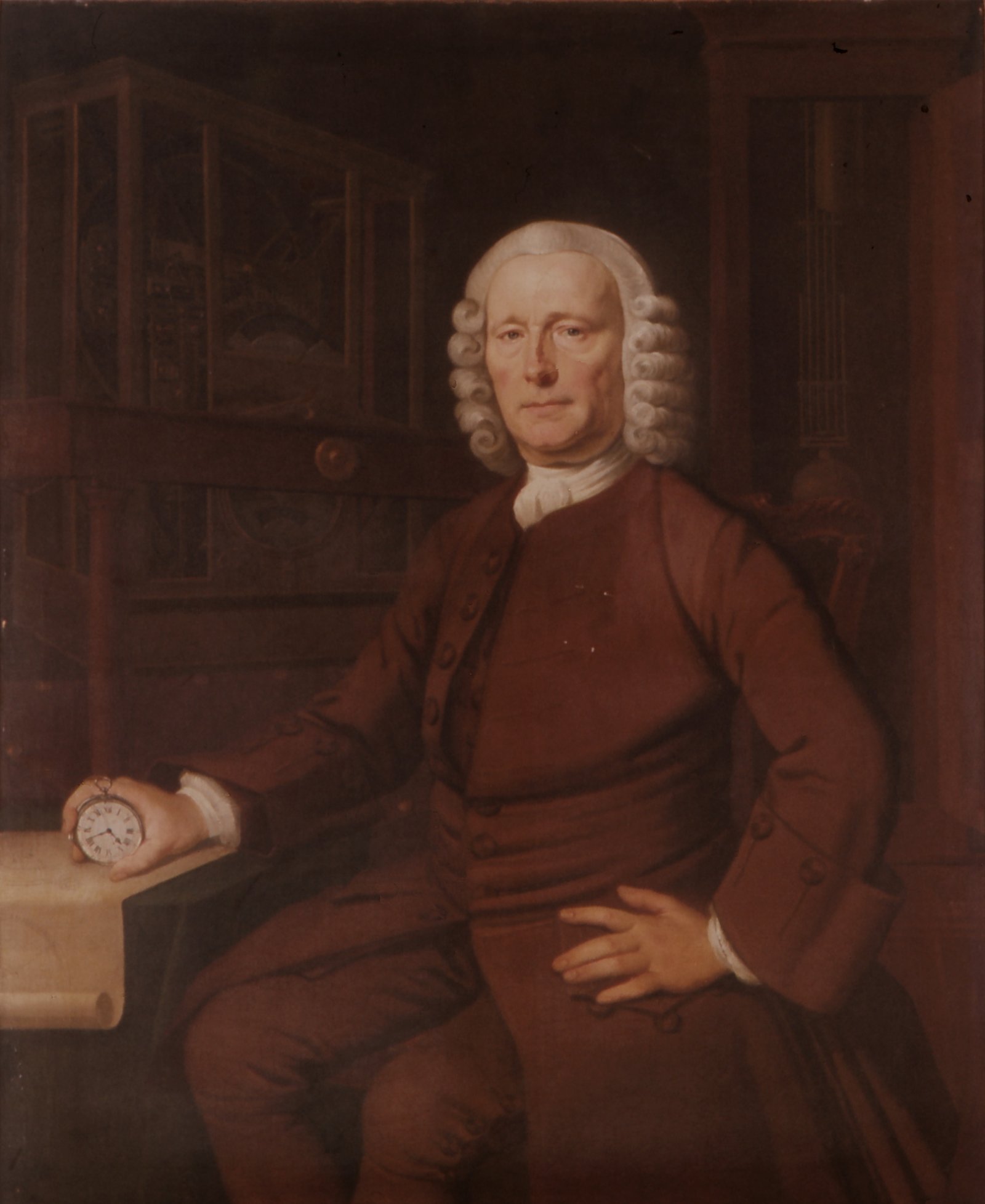
John Harrison
What they knew about curiosity · II
In 1736, a carpenter from Yorkshire sits before a commission of the mightiest seafaring nation on earth and does something nobody has quite managed to explain since: he talks his own work down. And this although his idea, his approach, was the right one. Which wasn't good enough for him.
His clock has just corrected the navigator of the Orford on the passage home from Lisbon — by sixty miles; the coast lay somewhere other than where the professionals believed. Sitting on the table, within reach, is therefore the largest prize in the history of science: twenty thousand pounds, posted by Parliament in 1714 under the Longitude Act for a method of finding longitude at sea. Several million in today's money. All Harrison has to do is demand the prescribed trial voyage to the West Indies.
The competition, it must be said, was not fierce. A pamphlet of 1687 (title: Curious Enquiries — the man would have fitted right in on this site) proposed wounding a dog before departure, taking the dog to sea and leaving the knife at home, where someone would dress the blade with "powder of sympathy" at noon sharp each day, whereupon the dog on board, joined to the knife by occult connection, would howl and so announce home-port noon to the crew. The mathematicians Whiston and Ditton wanted ships anchored across the oceans at set intervals, firing shells for navigators to take their bearings by (Whiston reckoned with six hundred metres of water at most; the oceans saw it differently). And Edmond Halley pinned his hopes on the earth's magnetic field. None of it helped. Harrison's real rival was astronomy, the lunar-distance method — the only serious one.
Back to Harrison. He knew his road was the right one, and the sea trial had just shown it. Instead he explains to the gentlemen of the commission that in heavy seas his machine tends towards small irregularities of rate. They bother him. He asks for an advance of five hundred pounds to build a better one. The commission — convened for the first time in its existence, for him — grants two hundred and fifty.
To understand the head doing the negotiating there, you have to go back twenty years. John Harrison, born 1693 in Foulby, a carpenter's son: no apprenticeship, no guild, no London. He built his first clocks out of oak. What sounds like tinkering was a frontal assault on the trade's root problem: clock oil. The lubricants of the eighteenth century gummed up in the cold and thinned away in the heat, which is why every clock in the world ran more or less wrong, and the whole trade kept doctoring symptoms. Harrison struck out the cause. For the bearings he took lignum vitae, a tropical wood that weeps its own oil, and invented an escapement that runs almost without friction. His tower clock at Brocklesby Park has been going for a good three hundred years. Unoiled.
A man like that looks at a gap, and the gap looks back.
The longitude gap was the largest of his age. I read geography at university, and there the grid came free of charge: it simply lay beneath every map, a quiet lattice of lines that even geographers rarely spend many words on. That one half of that lattice was, for centuries, pure "assertion" is something you only learn if you dig. Latitude is a gift from the sky; any helmsman could read it off the sun. Longitude, by contrast, is a built thing. It needs the time at the home port — at sea, for months on end, through storm, salt and forty degrees of temperature swing. Newton considered such a clock practically impossible. Ships missed islands, ran onto rocks at night; in 1707, off the Scillies, some two thousand men died in a single evening, of an arithmetic error. Hence the twenty thousand pounds.
Harrison sank his teeth into this gap in a way for which the word perseverance is too friendly. After the first sea clock, thirty-four kilos of brass (the one he failed himself, see above), he built a second. It didn't satisfy him either. Then he began the third, and sat at it for nineteen years. Nineteen years of auxiliary springs, bimetallic strips, adjustments — one man alone in his workshop with an apparatus that simply would not do what it was supposed to. So that he could at least measure properly in the meantime, he had the watchmaker John Jefferys build him a pocket watch to his own design in 1753. Workshop kit, nothing more.
Then one day he looked at that kit properly.
The small, fast-beating balance of the pocket watch shrugged off the blows that wrecked his sea monsters. The principle he had spent two decades building after was the wrong principle. Harrison was past sixty when he admitted that to himself, the third machine all but finished on the bench. He started again. The fourth clock came out at thirteen centimetres, the format of an outsized pocket watch, and on the voyage to Jamaica it kept time so well that it actually beat the conditions for the top prize.
He never got the prize anyway. This is where the story usually gets bent into melodrama: the lone genius, cheated by a clique of envious astronomers. Dava Sobel's bestseller made that picture world-famous; the research has since taken it apart fairly thoroughly. The commission simply wanted to know whether this one wonder of a watch was a fluke, and whether anyone on earth besides Harrison could build such a thing — for a public body, a not entirely unreasonable question. Harrison saw expropriation and conspiracy in it, stonewalled, raged, wrote rambling pamphlets. Both sides had their reasons, and both made each other's lives hard. Only when a copy of his watch ran faultlessly for three years on James Cook's second circumnavigation (Cook's log calls it his never-failing guide) was the proof in. Harrison was past eighty by then. He was, by the way, paid handsomely in the end — in instalments across forty years, more in total than the advertised sum. Only the certificate, the official win, the being-proved-right: that never came. It rankled him to the last.
The quiet thing about this revolution, as with John Rae, is that you can no longer see it. Rae's strait sits on every Arctic chart; Harrison's answer sits inside every coordinate — which has long since become furniture. Anyone glancing at a phone today and seeing a blue dot on a map is using the answer to a question a carpenter sat over for forty years. And like Rae, Harrison was first thoroughly forgotten. For different reasons. His four machines lay in Greenwich for over a century, quietly rusting, until in the 1920s a retired naval officer named Rupert Gould spent years of his own time coaxing them back into ticking. Rae got his plaque in Westminster Abbey in 2014, a hundred and twenty years after his death. Two men who made the world more measurable, and slid out of the picture for it. History has a soft spot for the loud ones, the shining heroes like Cook; its maps, though, are drawn by the quiet ones.
In The Lab on this site there is a curiosity type I call the Digger. What drives him is the open gap that aches until it is closed — and behind every closed gap, the next one opens. His curiosity is rarely joy, almost always relief. If that type ever needed a face: it wears a wig and smells of lignum vitae. Forty years on one problem, five machines, each an objection to the one before.
One more word — his own. Of the fourth watch, old Harrison wrote that there was no mechanical or mathematical thing in the world "more beautiful or curious in texture". Curious, back then, meant: made with the utmost care. The same word we now use for the hunger for the new once named devotion to detail, both from the same Latin root, cura — care. Harrison probably never gave it a thought. He simply lived it for forty years, both meanings at once.
He died on 24 March 1776, in London. By the old calendar, it was his eighty-third birthday to the day. The man spent his life measuring time, and at the end his own clock went once round and stopped on the very stroke it had started on.
Keep digging.
The gap that won't let go — sound familiar? Find out what kind of curious you are: the test in The Lab.